My new e-book: The Facepainter Murders

My new book has been online at writewordsinc.com and at amazon.com, but the cover art hasn’t migrated to the initial listing. I thought I would post it here, along with a brief synopsis.

The Facepainter Murders

Anne McPhail, doctor and genealogist, is back visiting friends in Culver’s Mills, Vermont. She finds a murdered, naked man in the lane behind her friend’s home. The corpse is identified as an art thief from Montreal, who has stolen works from the local gallery.

Anne researches the ownership of the paintings back to painter Zedekiah Belknap, a facepainter or itinerant artist of the early nineteenth century, and forward to the actual owner of today.

Someone has killed the thief, and then others in his criminal gang, finally turning his attention to Anne.  She escapes the attempts on her life, discovers the identity of the murderer, and the secrets of the painting he has stolen.


Wikileaks

http://www.bbc.co.uk/news/world-us-canada-11847824

Wikileaks is threatening to reveal millions of confidential diplomatic papers, which they hacked from secure government servers, with the express purpose of holding the US government to account.

I think we should remember that the US, during much of the time covered by these documents, was and remains in a state of war, as we do in Afghanistan. Diplomacy between countries, has never, anywhere, included frank disclosure of all details, in a great lump, to all the people of the world. The folks at Wikileaks seem to think that they are capable of deciding what will be safe to reveal, not putting people at personal risk, or countries at risk of war.

http://www.bbc.co.uk/news/world-11047811

The link above leads to a profile of the charismatic founder Julien Assange, a man who is said to go for weeks while eating little and sleeping less. Apparently we are to believe that a sleep-deprived, malnourished fanatic is the best person to filter through diplomatic cables and e-mails, decide they won’t put people in harm’s way or start wars, and release them  to a shocked population. Not to forget that this man is stealing the intellectual property of others.

I agree that governments lie to us, ours certainly does, spin after spin, and perhaps I’m like Diogenes, looking for that one honest man in politics who will tell us the facts, put them in context and lead a party of clarity and honesty, but I don’t want vast quantity of so-called facts, filtered by Assange’s acolytes, and released around the world for their shock value.

By the way, what has happened to the diplomatic pouch? Wikileaks can’t hack what isn’t in cyberspace.


Spain, final thoughts

Two weeks is a short visit to another country, barely time enough to get a limited sense of the geography, no time at all to get a sense of the people, no time except to feel the otherness of the place.

“How was your vacation?” people always ask.

“Loved Madrid, didn’t like Sevilla, thought the pueblos blancos and the mountains beautiful and overwhelming,” I would say.

But even a brief two weeks, alters perception, preconceived notions of a country, and creates a desire to know what is going on there, how are the people doing, what is preoccupying the nation. Before October, I didn’t care whether the banks were failing, or what was happening to the mortgage market, or how many were unemployed, and what that would mean for the people we met, and the way of life we observed.

Madrid was happy, the plazas full of families, the museums with Spaniards on vacation, the skyline with cranes. Sevilla was sad, the streets, where we were anyway filled with tourists, the clerks in the stores and hotels and bars glum, the pueblos blancos, photo-ops that they all were, closed in and except for the British, oblivious to the visitor.

The news from Spain economically isn’t good, especially for the immigrants from the Spanish-speaking countries of the new world. An article today in the New York Times, and late in October in the Globe and Mail talked about the draconian banking laws that prevent individual bankruptcy  proceedings from including a mortgage. The result: the borrower and the guarantor are tied for life to the bank, paying off a debt even though the house is no longer theirs.The banks say this prevented their failure during the economic crisis. The entire sorry tale is available here:  http://www.nytimes.com/2010/10/28/world/europe/28spain.html?_r=1&scp=6&sq=spain&st=cse


Spain has beautiful cities, ancient villages where Phoenicians and Romans and Berbers walked before we did, and an unexpected, vast landscape. It’s in Europe, yet partly outside it too. I’m glad we went, even it was only two weeks.


My new book, The Facepainter Murders is available at Amazon.com and at http://www.writewordsinc.com

Malaga, Spain

We left Ronda, taking one of the major highways to the coast. Fabulous views opened at every switchback curve–and there were many. At one point it was possible to see four widely separated white towns shining against the background of granite crags and olive trees. Further south we came across forests of pine. I have no pictures from this drive because, although the highway was modern, in good condition and wide enough, there was no possibility of pulling off.

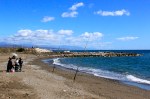
We found our small hotel, single story, set behind walls, with an inner courtyard and pool, in a residential neighbourhood. It was also a ten-minute walk from the sea. We walked along the sea, in sunshine, watching children playing on the stony beach, and men fishing. Further along was a seaside restaurant, a man behind grilling sardines in the old-fashioned way with an open fire.

Olvera and Setenil

We left Acinipo, turning left instead of right as the GPS advised, and followed a winding road down the mountain, en route to Olvera. We stumbled upon Setenil, a town set into the mountain, like the pueblos in New Mexico, the roofs of some of the houses formed by overhanging rock. Leaving Setenil, we followed tiny roads through miles of olive trees and mountain vistas to Olvera.

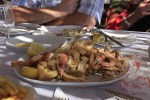
There has been human population at Olvera for 12,000 years according to a website found here: http://www.andalucia.com/province/cadiz/olvera/home.htm . Construction of the village as it stands was begun by the Berbers(Moors) whose castle stands high above it . One of the most beautiful of the white towns, it has steep, very steep streets(with handrails) leading up to the church which dominates the view up to the fortress. We had lunch in the plaza, in a restaurant run by an English couple. “Why are you here,” one of us asked. “I followed her,” he said, jerking his thumb towards the kitchen.

I have attached some pictures.

Acinipo

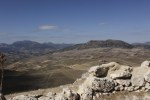
We met our friends at the villa in Ronda, and stayed for a week, driving, thanks to Alan’s skill on mountain roads, to several pueblos blancos(white villages) and to the Roman ruins at Acinipo, only a few kilometres and two centuries from Ronda, the rubble of a Roman town, established, it is said, for retired soldiers, with a population of 5000. Today it is a windswept hillside, dotted with what we called “stone boats”, the remains of houses, the rubble collected and piled up by farmers reclaiming pasture land, dominated by a wall of memorial, and behind it, the amphitheater. The walk goes up and up to a low stone wall, with views, from 1000 m of the Serrania de Ronda. There is a lonely farm on the site, the fields crisscrossed with goat and donkey paths.

The four of us shared Acinipo with only two other travellers, and the ghosts, that day.