Malaga, Spain

We left Ronda, taking one of the major highways to the coast. Fabulous views opened at every switchback curve–and there were many. At one point it was possible to see four widely separated white towns shining against the background of granite crags and olive trees. Further south we came across forests of pine. I have no pictures from this drive because, although the highway was modern, in good condition and wide enough, there was no possibility of pulling off.

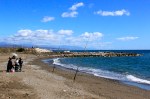
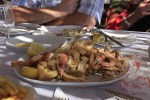
We found our small hotel, single story, set behind walls, with an inner courtyard and pool, in a residential neighbourhood. It was also a ten-minute walk from the sea. We walked along the sea, in sunshine, watching children playing on the stony beach, and men fishing. Further along was a seaside restaurant, a man behind grilling sardines in the old-fashioned way with an open fire.

Olvera and Setenil

We left Acinipo, turning left instead of right as the GPS advised, and followed a winding road down the mountain, en route to Olvera. We stumbled upon Setenil, a town set into the mountain, like the pueblos in New Mexico, the roofs of some of the houses formed by overhanging rock. Leaving Setenil, we followed tiny roads through miles of olive trees and mountain vistas to Olvera.

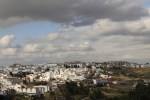
There has been human population at Olvera for 12,000 years according to a website found here: http://www.andalucia.com/province/cadiz/olvera/home.htm . Construction of the village as it stands was begun by the Berbers(Moors) whose castle stands high above it . One of the most beautiful of the white towns, it has steep, very steep streets(with handrails) leading up to the church which dominates the view up to the fortress. We had lunch in the plaza, in a restaurant run by an English couple. “Why are you here,” one of us asked. “I followed her,” he said, jerking his thumb towards the kitchen.

I have attached some pictures.

Acinipo

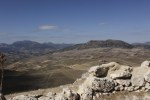
We met our friends at the villa in Ronda, and stayed for a week, driving, thanks to Alan’s skill on mountain roads, to several pueblos blancos(white villages) and to the Roman ruins at Acinipo, only a few kilometres and two centuries from Ronda, the rubble of a Roman town, established, it is said, for retired soldiers, with a population of 5000. Today it is a windswept hillside, dotted with what we called “stone boats”, the remains of houses, the rubble collected and piled up by farmers reclaiming pasture land, dominated by a wall of memorial, and behind it, the amphitheater. The walk goes up and up to a low stone wall, with views, from 1000 m of the Serrania de Ronda. There is a lonely farm on the site, the fields crisscrossed with goat and donkey paths.

The four of us shared Acinipo with only two other travellers, and the ghosts, that day.

Ronda

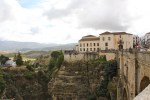
A battle ground for much of its turbulent history, beloved of artists like Ernest Hemingway, Washington Irving and Orson Welles–whose ashes were scattered there—an incredible sight for any traveller, jaded or not, Ronda and its  El Tajo, astonishes, no matter how many times its pictures have appeared on web sites and in travel guides. Nothing can prepare you for the gorge and the views over Andalucia. Ronda was a Moorish city until 1485 when it fell to the Christian reconquest, its position in the mountains–685 metres above sea level, and its 1000 m gorge keeping it unassailable for much of its history. Now it is overrun with tourists, daytrippers from Malaga mostly.

We stayed in a villa–La Cancela–a lovely little house a few kilometres into the countryside north of Ronda, owned by a most accommodating English lady, a perfect entry point to the Pueblos Blancos, and to Ronda.

The bullring sits in a park in the newer part of Ronda, built after the conquest. The building itself is beautiful, elegant arches in sandstone, overlooking the arena, the same colour in the sand, except where it is stained in red. A museum in the interior outlines the history of bullfighting, containing “suits of lights”, pictures, weapons and the mounted heads of some unfortunate bulls.

El Tajo is the draw, in spite of the bullring, the shopping, the museums and churches—a “see before you die” experience”.

Sevilla

Giralda in Sevilla

After three days in Madrid, we took the AVE train to Sevilla, very fast, very comfortable but oddly not very accessible, especially for older travels with heavy suitcases. Younger travellers were very kind and helpful, which the train staff were not. City centre to city centre is very convenient though.

Sevilla is a beautiful city, with lovely plazas and a magnificent walk along the Guadalquivir River. We stayed in the barrio Santa Cruz and I was disappointed in our hotel-Petit Palace de Sant Cruz- and uncomfortable in the area. Unless you are a fan of narrow and closed-up streets –no windows, shuttered shops, and what seemed to be unfriendly faces, choose another section of the city. We loved our stay in Venice a couple of years ago and I thought this would be similar, but it wasn’t.

The Cathedral in enormous, but the most beautiful feature was the Giralda-the bell-tower converted from a minaret– that stands beside it. The gardens of the Alcazar, and the lovely tile work within it, the parks and the paseo along the river, the narrow Calle del Agua and the restaurant Corral del Agua–all memorable. After three days we were off on the bus to Ronda.

Madrid

We stayed in Madrid for only three days. I had wanted to see Picasso’s picture Guernica, and we did, and it was as moving as I had expected. The room at the Reina Sofia museum is set up to allow the viewer to see the studies he did for the completed painting. A film running continuously in an alcove depicts the horror of the Spanish civil war, and the events which led Picasso to paint Guernica. Most of the people who were there the day we saw it were Spanish. I can only imagine the impact the painting and the film had on them.

There was a general strike called during the time we were in Madrid.I understand that the media reported clashes with police and other violence. Didn’t happen where we were, near the Congress of Deputies. The night before there was a concert in support of the strike action in Plaza Sant Ana outside our hotel. We sat in the plaza, drank wine, ate tapas, sang along with the familiar protest songs, watched the children play. The only evidence of any official concern was a brief visit by three police. The next day there was heavy police presence, including helicopters flying constantly over the city, continuing into the evening.

We saw the Prado- including Las Meninas,Velasquez’s painting, called one of the, if not the most, important paintings in the history of Western art; Goya’s Third of May, 1808 and Second of May, 1808, the first having more impact for me than Guernica, because of the realistic depiction of the executions; and the Clothed and the Naked Maja.

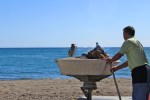
Cleaning Plaza del Angel

The picture at left is of an amazing and amusing bronze in the neighbourhood of our hotel.

I  loved Madrid, its beauty, its museums, its vibe. I wish we had stayed longer.

Spain

View from Puerto de Las Palomas

Back from Spain and trying to recover from the jet-lag which always seems worse going East to West, at least for me.

I had investigated all the aspects of Spain that I thought I needed to know, but was still astonished, primarily by the geography. Those Pueblos Blancos are not hill towns, similar to Tuscan ones. No, they are mountain towns, nestled into granite, streets with pitches so steep some of them had handrails. The day we visited Zahara, we took a wrong turn, found ourselves on a road that wound through the mountains by a series by switch-backs,  reached a peak of thirteen hundred and sixty-seven metres, before we descended again to Grazelema. Frightening but unbelievably beautiful.

I’ll write more when the fog clears.

Off to Spain

I have been watching a lecture series on DVD, produced by The Teaching Company, taught by Professor Brooks Landon of the University of Iowa,  entitled Building Great Sentences: Exploring the Writer’s Craft. This is my first exposure to a university level course in writing, although I have taken other on-line practical writing courses and attended workshops, and read books on the subject, all practical, none with the in-depth discussion of the sentence as an art form, not considering just its function, but the way in which phrases and clauses, vowels and consonants play against and with each other. I’m enjoying this series, although some of the concepts are so new to me, that I will watch it a second time, take notes, do the exercises and explore at greater length some of the concepts, as well, I might add, as learning the new vocabulary, not included in the language I learned in medical school. It seems a practical course in many ways and it is great fun.

Sakineh: She’s still in that prison. I see that the Iranians have accepted five hundred thousand dollars as the price of an American woman accused of spying and released this week. Some people in Oman arranged it, so we are told. I wonder what it would cost to buy the freedom of Sakineh and the others.

Spain: I’ve spent the last few months trying to learn some Spanish, using the course supplied by RosettaStone, enough to be polite, and not assume that everyone that I meet speaks English. I did the same with Italian several years ago, finding that it took at least two years to gain enough language to communicate a little. It becomes more difficult as I get older, or so it seems. We’re leaving shortly, so this will be my last posting for a while, unless I have access to a computer somewhere along the way.

Spain

Our vacation in Spain is drawing closer. Our hotel in Madrid is on Plaza Santa Ana, ringed with cafes, bars and a highly-rated restaurant! The hotel itself is in a converted office building– high ceilings and large windows overlooking the plaza. We hope to visit the Reina Sofia museum of modern art to see Picasso’s Guernica on the first day, if we aren’t too tired after the plane.

So much else to do and see in Madrid that it would likely take three weeks rather than the three days we have there to begin to see it all.

We leave Madrid by the AVE, the fast train to Seville, arriving at yet another hotel in a converted building, this one in Barrio Santa Cruz. We haven’t an plan for Sevilla, although visiting the cathedral, the third largest medieval in the world after St. Peter’s in Rome and St. Paul’s in London, is on the list. We are there for three nights, before meeting Anne and Alan in Ronda.

The trip to Ronda will be an adventure: a bus trip through the Serrano Mountains. The owner of the villa we are renting promised to meet us that day and drive us to her finca(country property). She is also making dinner for us that evening. Visiting Ronda, a fabled town renowned in the nineteenth century for bandits and bullfights, should take at least two days of the seven we will be staying there. After that, visiting the Pueblos Blancos, the white villages, beginning, I think, with Arcos de la Frontera, the furthest from Ronda, situated on the edge of the sherry district. All the villages with frontera in their names were on the frontier, built for defence, high on the hills, the front lines of the battles to retake Spain from the Moors.

I can hardly wait!

Madness in Iran

Iranian woman could be executed this week, son says – The Globe and Mail.

It’s so horrifying, it’s hard to keep writing about it. I can’t imagine living it. Sakineh remains in that hell-hole of a prison, at the mercy of authorities who have no sense nor compassion. Ramadan ends so her son, who hasn’t seen her for weeks, believes she will be executed sometime after Thursday.

An idiotic British newspaper publishes a picture purporting to be Sakineh without a headscarf. It isn’t; it’s another woman, but the sadists in that prison lash her 99 times, again. How much can one woman endure? The Iranians do all this in the name of religion. I don’t believe it. I think the people in charge have the same sadistic, murderous minds and souls that Nazi concentration camp guards had, and in a better world, they would be the ones in the prisons.

The British newspaper bears considerable responsibility. What did the editors think would happen to Sakineh when they published that picture? Or do they share the same sadistic mind-set, oblivious to the suffering of their victims?

Please sign the petition http://www.freesakineh.org